Healing Arts Ukraine: Arts and Health Congress
From 27 to 30 June, Lviv hosted the Congress of Arts for Health, bringing together 100 representatives of universities, healthcare and cultural institutions, government bodies, and professionals working at the intersection of arts and health.
The four-day programme aimed to advance evidence-based approaches to integrating the arts into healthcare and recovery systems. It included keynote presentations, expert discussions, facilitated working sessions, and showcases of Ukrainian and international practices.
The working sessions focused on:
- mapping stakeholders involved in developing and implementing arts and health policies in Ukraine;
- identifying international experience most relevant for adaptation to the Ukrainian context;
- defining effectiveness indicators and approaches to evaluating arts-on-prescription programmes in Ukraine.
The Congress contributed to strengthening cross-sectoral cooperation, consolidating existing knowledge and practices, and developing policy recommendations for the Ministries of Culture, Health, and Social Policy of Ukraine on integrating arts-based approaches and arts prescription models into healthcare and recovery systems. The document based on the Congress discussions is currently being prepared and will be shared with relevant ministries.
Programme
27 JUNE. OPENING
Location: Lviv City Council, Rynok Square, 1
17:00–17:30 – Registration
17:30–19:00 – Opening. Keynote speeches by organisers and guests
-
Veronika Skliarova, director of Art Dot NGO / Art Therapy Force
Christopher Bailey, former head of Arts & Health at the WHO, Co-founder of Jameel Arts & Health Lab
Andrii Sadovyi, mayor of Lviv
Henry Redwood, senior Lecturer in War Studies at King’s College London
Lesya Khemrayeva, head of the Accessibility Policy Department at the Ministry of Culture of Ukraine
19:30-20:30 – Showcase event / “The Lift Manager” / The Unbroken Theatre and First Theatre production / Courtyard of the City Hall
28 JUNE. ARTS AND HEALTH IN UKRAINE AND ACROSS THE WORLD
Location: Hotel “Dnister” (Park Hall), 6 Yan Mateyko Street
09:30–10:00 – Registration
10:00–10:30 – (key note) Ameer Shaheed, consultant, Arts and Health, World Health Organization / Jameel Arts & Health Lab
10:30–11:15 – Presentation: “Mapping Culture and Health Assets in Ukraine. Building Arts and Health Capacity (BACH) to mental and physical health and well-being in Armenia, Azerbaijan, Georgia, the Republic of Moldova and Ukraine”
-
Veronika Skliarova, director of Art Dot NGO / Art Therapy Force
Ameer Shaheed, consultant, Arts and Health, World Health Organization / Jameel Arts & Health Lab
11:15-12:00 – Book presentation: “Support through Creative Practice: A Methodology for Artists Working in Humanitarian Contexts”
-
Christopher Bailey, former head of Arts & Health at the WHO, Co-founder of Jameel Arts & Health Lab
Olha Vasina, translator
12:00–12:30 – Coffee break
12:30–14:30 – Panel 1: “Evidence-Based Practices of Innovative Methods of Arts Integration into Medicine”
-
Nigel Osborne, composer, art therapist, teacher, health Worker
Vladyslava Andrushchenko, clinical psychologist, board member of the Ukrainian Association of Clinical Psychologists
Iryna Holubetska, head of the Centre for assistance to ukrainians affected by captivity, torture and moral injury as a result of war
Marc Boumeester, researcher, author, and developer of educational programmes in media and visual arts
Moderator Jonathan Walton, musician, computer programmer, and clinical trials manager for Х-System epilepsy work
14:30–15:30 – Lunch
15:30–17:30 – Workshop 1: “Mapping Stakeholders in the Process of Implementing Arts and Health Policies”.
18:30–19:30 – Showcase event / Audio Walk “Callsign: Odyssey” / Starting point: Lviv City Hall
19:30–21:00 – Showcase event / A conversation with Yurko Vovkohon, Kateryna Mykhalitsyna, and Bohdan Kordoba as part of the exhibition “Novellas of the Characternyk Cat.”/ Stefanyka Street, 11
29 JUNE. ARTS ON PRESCRIBING
Location: Unbroken Centre, 25d Hetmana Mazepy Street
10:00–10:30 – Registration
10:30–11:30 – Tour of the Unbroken space
11:30–13:00 – Panel 2: “Arts and health in European frameworks”
-
Sir Gregor Smith, GP and former medical director for primary care in NHS Lanarkshire
Monica Urian, policy officer at the European Commission – Directorate General Education and Culture – responsible for international cultural relations.
Kornelia Kiss, Head of Culture and Health at Culture Action Europe (CAE)
Angela Kennedy, consultant clinical psychologist who comes from senior leadership roles in the NHS and Integrated Care System
Moderator Ameer Shaheed, consultant, Arts and Health, World Health Organization / Jameel Arts & Health
13:00–14:00 – Workshop 2: “What international experience is the most relevant for adaptation to the Ukrainian context?”
14:00–15:00 – Lunch
15:00–15:15 – Keynote (Charlotte Osborn-Forde)
15:00–16:00 – Panel 3: “Arts on Prescription. Complementary Arts and Social Practices for the Healthcare System”
-
Christopher Bailey, former head of Arts & Health at the WHO, Co-founder of Jameel Arts & Health Lab
Oleh Bereziuk, psychiatrist, psychotherapist, and Head of the Mental Health Service at the UNBROKEN Rehabilitation Center
Iryna Kulynich, deputy mayor of Lviv for humanitarian affairs
Charlotte Osborn-Forde, CEO of the National Academy for Social Prescribing
Moderator Svitlana Soloviova, physician, clinical expert at the Association of Public Health Experts, Head of the NGO PROZDOROVYA
16:00–17:00 – Presentation of arts and health initiatives
17:00–18:00 – Presentation of opportunities in Arts and Health: Ukrainian and international organisations (British Council, UAx, ЗMIN Foundation, ZDOROVI Agency)
18:00–18:30 – Coffee break
19:30–20:30 – Showcase event / Concert on the Unbroken terrace featuring veterans, the Lviv Philharmonic Symphony Orchestra, and the INSO Symphony Orchestra
30 JUNE. WRAPPING UP
Location: Hotel “Dnister” (Park Hall), 6 Yan Mateyko Street
09:30–10:00 – Registration
10:00–11:30 – Workshop 3: “Arts on Prescription” in Ukraine: from global experience to a national model. Effectiveness indicators for implementing the “Arts on Prescription” programme: criteria of relevance for Ukraine.
11:30–12:00 – Book presentation: “Trauma-Attuned Arts Framework”
-
Veronika Skliarova, director of Art Dot NGO / Art Therapy Force
Henry Redwood, senior Lecturer in War Studies at King’s College London
Darren Abrahams, singer, trauma therapist, founder of The Human Hive, and co-founder of One World Orchestra
12:00–12:30 – Coffee break
12:30–13:30 – Panel 4: “Responsibility to Be: Cultural Practices of Healing, Imagination, and Presence”
-
Yuliia Khomchyn, director of the Institute for Cultural Strategy
Andrii Linik, director of LME “Lviv Radio”
Grigory Semenchuk, Poet, Musician, and cultural practitioner, head of the Artistic Council “Dialogue”
Ihor Kolesnyk, Cultural Studies scholar, Founder of the Laboratory of Secular Meditation
Moderator Bohdan Shumylovych, researcher, cultural historian, and associate professor at the department of cultural studies, Faculty of Humanities, Ukrainian Catholic University
13:30–15:00 – Presentation and discussion of congress outcomes (Anna Valensa)
15:00–15:30 – Closing remarks. Congress closure / Photo
17:00–18:00 – Showcase event / Screening of the film “This is also Ukraine” / Dzyga Gallery
RESULTS
Mapping the Arts & Health sector in Ukraine: shared and diverging perspectives of stakeholders
During the first workshop, participants mapped key stakeholders and the relationships between them within the Arts & Health sector in Ukraine. The work of seven groups revealed a shared understanding of the main challenges: the fragmentation of the field and the need for institutionalisation and government recognition, professional standards, an evidence base, and sustainable funding.
Participants also identified key steps for developing the field: establishing an intersectoral working group and a national Arts & Health strategy, strengthening cooperation between the cultural, healthcare, education, research, and government sectors, and developing Arts on Prescription mechanisms.
Particular attention was paid to the role of beneficiaries. Although they should be at the centre of the system, they are often perceived as passive recipients of services. Participants emphasised the need to generate genuine demand for these practices by raising public awareness of the potential of the arts to support health and wellbeing.
The mapping also demonstrated that Ukraine already has a wide range of Arts & Health practices. The next step should be to connect these initiatives into a network, strengthen the evidence base, and establish sustainable mechanisms of support and funding.
What international experience is most relevant to the Ukrainian context?
During the second workshop, participants identified what needs to be developed to establish Arts & Health as a systemic field in Ukraine, as well as the international expertise and partnerships needed to support this process.
The work of four groups highlighted several key priorities:
1. Legislation and policy: institutionalising the profession of art therapist, developing standards for education and services, strengthening cooperation with government institutions, and establishing sustainable funding mechanisms.
2. Research: launching large-scale national research on the impact of the arts on health, adapting international methodologies to the Ukrainian context, and strengthening cooperation between researchers and practitioners.
3. Service delivery mechanisms: creating clear mechanisms for cooperation between the cultural, healthcare, education, and social sectors, developing funding models, and training qualified professionals.
4. Practices relevant to Ukraine: developing trauma-attuned arts-based practices adapted to the context of war.
International cooperation emerged as a cross-cutting priority. Participants stressed the importance not only of learning from European and British experience, but also of speaking and listening — sharing Ukrainian practices, developing joint research and educational programmes, internships, publications, and international projects.
Arts on Prescription in Ukraine: from international experience to a national model
During the final workshop, participants explored the effectiveness and relevance criteria for an Arts on Prescription programme in the Ukrainian context.
The groups identified five key priorities for a future model:
1. Intersectoral funding — drawing resources not only from the healthcare system, but also from cultural institutions and local budgets;
2. Trauma-attuned practice — focusing on the needs of people affected by the consequences of war and minimising the risk of retraumatisation;
3. Compatibility with Ukraine’s eHealth system (eZdorovya) — integrating arts-based services into the healthcare system and making them accessible through referrals from healthcare professionals;
4. A process-oriented approach — focusing on a safe creative process, social connection, and support rather than assessing artistic outcomes;
5. Accessibility and inclusion — ensuring that such services are available in hospitals, rehabilitation centres, cultural institutions, and local communities.
Additional priorities identified by participants included multidisciplinary and multimodal approaches, mental health and arts education, greater public awareness of Arts & Health, and support for psychological wellbeing and societal resilience.
Facilitator’s conclusions and recommendations
The Congress demonstrated a high level of interest among the professional community in developing Arts & Health in Ukraine, as well as participants’ readiness to share knowledge, teach, conduct research, and collaborate.
At the same time, the community lacks a comprehensive understanding of how the system works and how policy change can be achieved. Developing not only professional expertise but also systems thinking and advocacy capacity is therefore essential.
Another key challenge is stimulating demand. While the field is actively developing the supply of services, it also needs greater public awareness, trust, and agency among beneficiaries and communities.
The further development of Arts & Health should bring together the experiences and needs of beneficiaries and practitioners with the systemic perspectives of government, institutional, and international stakeholders. This requires sustained cross-sectoral cooperation between the cultural, healthcare, education, social, research, government, and local sectors.
Recommendations:
1. Begin developing a national Arts & Health strategy, using the Congress outcomes as a basis for an advisory document and dialogue with government institutions.
2. Establish an intersectoral coordination mechanism bringing together key stakeholders.
3. Strengthen the systems and advocacy capacity of the professional community.
4. Develop both the supply and demand for Arts & Health: professional standards, supervision, an evidence base, and funding alongside public awareness and meaningful beneficiary engagement.
5. Continue facilitated dialogue to align interests, exchange experience, and develop a shared vision for the field.
Facilitation and conclusions: Anna Valensa
Conclusions and Recommendations for state authorities and local government bodies
In response to the urgent challenges facing the mental health, social cohesion and resilience of Ukrainian society as a result of the full-scale war, and drawing on the growing international evidence of the impact of arts and culture on health, as well as the findings of the cross-sectoral expert focus group held as part of the Congress, we have prepared these conclusions and recommendations as a shared position of the Congress participants and an appeal to national and local authorities.
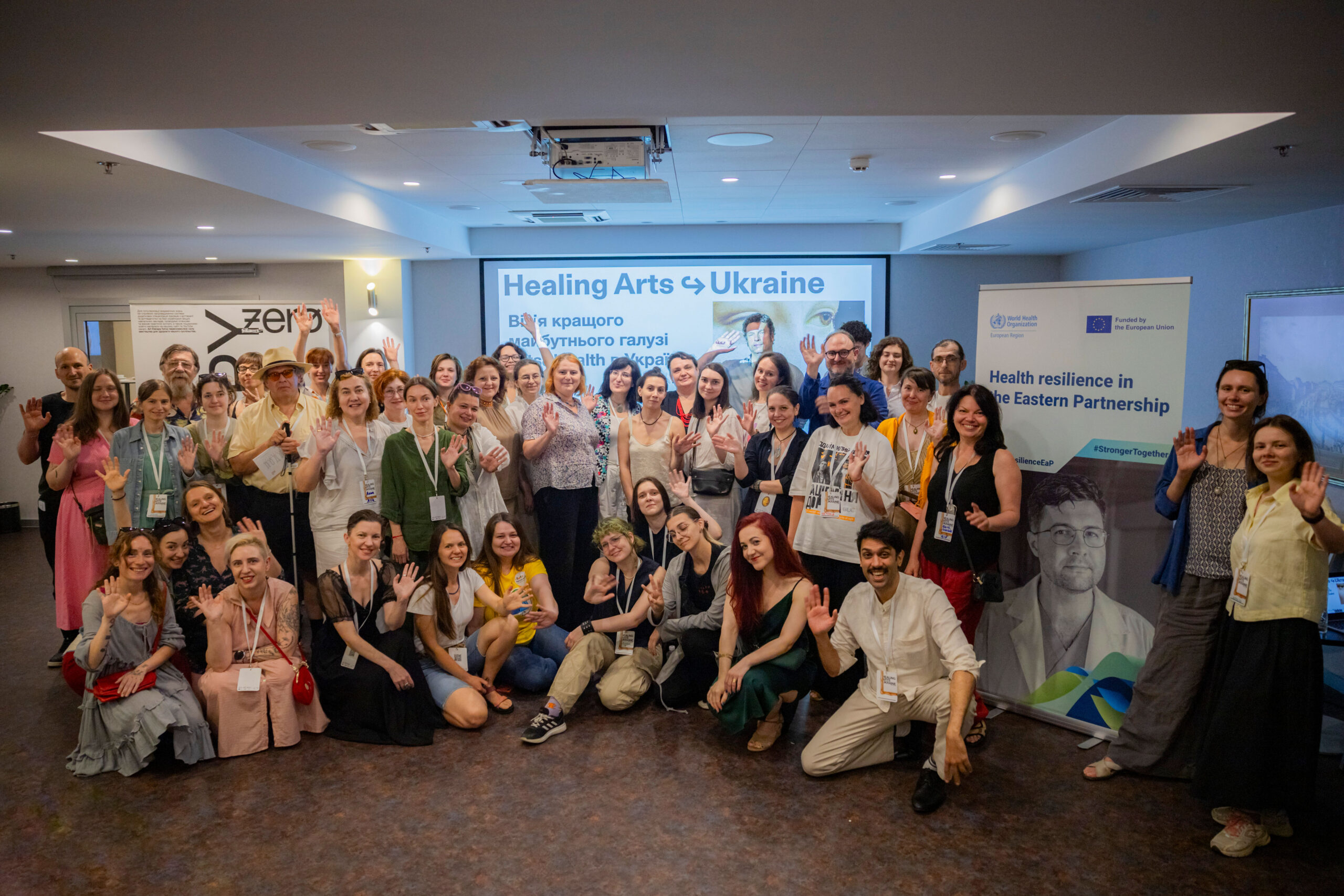
The Arts and Health Congress is part of Healing Arts Ukraine — an arts and health campaign to support military health, veteran recovery and civilian resilience in times of conflict.
Healing Arts Ukraine is implemented by Art Therapy Force as part of the global Healing Arts initiative by Jameel Arts & Health Lab, with the support of the WHO Regional Office for Europe under the Health Resilience in the Eastern Partnership programme, funded by the European Union. It is delivered through a national coalition of organisations working at the intersection of culture, healthcare, education, and policy, including the Lviv City Council, Lviv Radio Municipal Enterprise, the Institute of Culture Strategy, the UNBROKEN rehabilitation centre, and King’s College London.
Might be interesting: